Monday, December 31, 2007

The Story of the Barred Owl (Strix varia)

Location: Sumter Oaks Park, Bushnell, Fl

On my last day in this park, the Barred Owl I have been searching for showed up! And I heard his story from some folks who were staying here last year:

Once upon a time, there were two Owls who lived in the great Oak Trees that ring Sumter Oaks Campground. Mama and Papa Owl were very much in love, and soon their nest was filled with cooing baby owlets! Mama Owl went hunting one morning, and probably saw a tasty Mr. Mouse scurrying along the roadside. She fixed her gaze on Mr. Mouse, and began her Dive of Death. Oh, no! Mr. Automobile came around the bend, just as Mama Owl reached the road. Splat! Mama Owl died there on the asphalt. The Humans in the campground found her, and they felt sadness for her and for the motherless baby owlets. "What would become of them?" they wondered. But Mother Nature understands how to care for Her offspring, and gave Papa Owl the wisdom and knowledge to care for his baby chicks. And this he did, and when they were old enough, the baby owlets flew from the nest and began their Life on the Wing. Who knows? Maybe this owl was one of those chicks. Or just maybe it was Papa Owl himself! Probably, though, it's just some owl that wandered into the campground and doesn't really give a hoot about any of this.

Second Seminole War Begins - A Reenactment

Location: Bushnell, Florida

On December 28th, 1835, Seminole Indians fought U.S. soldiers under the command of Major Francis Dade, on a field which would eventually become part of Bushnell, Florida. The battle, the first of the Second Seminole War, is reenacted each year on the weekend after Christmas at the Dade Battlefield Historic Park.
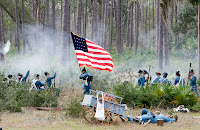
Click for Larger Image of the Battle ReenactmentThere were three Seminole Wars, (First: 1817 to 1818; Second: 1835 to 1842; Third: 1855 to 1858) but the Second is the one that has gone down in
history as the longest lasting war in American history. The conflict between the U.S. government and the Seminoles began during the Revolutionary War when the Seminoles were recruited by the British to fight against Georgian settlements. Long story short, a treaty in the First Seminole War required all Seminoles to relocate, by 1835, to what is now Oklahoma. While many did, some understandably resisted being forced from their home and land. They fought back, attacking plantations and a militia wagon train. Major Dade, with 108 men, was dispatched to reinforce Fort King near Ocala. As he passed through the Bushnell area, the Seminoles ambushed and killed all but two of the soldiers, one of them subsequently dying within a short time. Major Dade was one of the casulties.

In January, 1836, Dade County in Florida (now Miami-Dade) was created and named for Major Francis Dade.

Click for Larger Image of Seminoles Arriving At the BattlefieldAs the reenactment began, the "Seminoles," who had minutes before arrived in golf carts, hid in the thickets. The narrator, who played the part of the eventual sole survivor (on the soldier's side), entered from a path on our left, followed by the two companies led by Major Dade. When they stopped to rest, the hidden Seminoles attacked, "killing" all but two of the soldiers. As the battle ensued, the narrator followed the action from his point of view, which was very much "us versus them," and interspersed with colorful language urging his fellow soldiers to kill the Indians. There was no narrator for the Seminoles.

Click for Larger Image of Victorious SeminolesHistory is a complicated business. Although the victors write the story, there is always another side. The Seminole's story has not been lost, but I found this reenactment to be very one-sided. The only attempt at providing a balanced experience was a folk singer who, before the reenactment, sang some moving ballads about the Seminoles losing their homeland. I would have liked to have seen a joint narration, one soldier, one Seminole. As it was, it felt more like the old "Cowboys and Indians" games we used to play as children, where the cowboys were always good and the Indians were always bad. This was a bit different, though. This time the cowboys didn't have horses or ten-gallon hats, and the Indians didn't lose.

Saturday, December 29, 2007

Florida Arachnids

Location: Bushnell, Florida


After braving the crowds at Wally World (AKA grocery shopping), I wandered the campground in search of insects or other small creatures to photograph. The colder weather in Texas had sent most of them for cover, so it was with a sense of excitement that I found a couple spiders that are still out enjoying the Florida warmth. As usual, click for a larger image.

  • A Golden-silk Spider (Nephila clavipes):
    Click for larger image of the Golden-silk Spider
  • A Crab-like Spiny Orb Weaver (Gasteracantha cancriformis)
    Click for larger image of the Crab-like Spiny Orb Weaver

Friday, December 28, 2007

Dry Camping On The Way To Florida

Location: Bushnell, Fl

I have just spent three days on the road travelling from Livingston, Texas to Florida. I had planned a more leisurely trip, with a two-day stop in Alabama, but I wound up driving more miles on Day One than I had planned, and it seemed a waste to only go two hours on Day Two. So I decided to save Alabama for a return trip, and pushed on to Florida.

I stayed both nights while on the road in a Flying J. Flying J's normally have a front area for cars and RVs, and a back lot for 18-wheelers. The front area has several long parking spots for RVs, and these are where the "dry campers" park for the night.

When I pulled in on the first night, those long front spots were cordoned off with tape. A Flying J employee was on hand to explain that they were setting up a fireworks tent at 5 am, so they were asking RVers to park in the back with the 18-wheelers. When I pulled around, there was only one pull-through site left -- the others were either sites that were against the back fence (requiring backing into now), or doubled in the second row behind a truck that was already parked (possibly requiring backing out in the morning if the front truck had not already left). I don't back well, and doing it in front of fifty truckers who DO back well would be just too embarrassing. I took the last pull through.

The truck to my right had his engine running, and I was hoping that it would not run all night. Of course, it did. Truckers usually run their engines for two reasons -- to keep the fuel from gelling in extreme cold, and to keep their battery charged to power accessories like heaters, refrigerators, and TVs. It wasn't cold enough for diesel to gel or to need heat inside the cab, and I doubt that the driver was planning to watch TV all night. But he didn't seem to be turning it off. So I resigned myself to a sleepless night, but an odd thing happened. I found that the diesel's rumbling provided a kind of blanket of white noise, and I actually had a very nice night's sleep.

The second night I parked in the front of a different Flying J, and had other RVers for neighbors. Here I could dimly hear the background noise of the station -- cars coming and going, piped music on the pumps, people on cell phones -- and, while much quieter than the diesel, I found it to be more annoying. I did sleep through most of the night, but I woke much more often.

I am now in another park run by the Escapees and will be here until January 1st when I will move to another RV park one exit away. Other RVers have told me that a family of barred owls frequent the large oaks here, so I went "hunting" just before twilight. I didn't see an owl, but I did see two wild turkeys looking a bit out of place as they perched high in a tree and made flapping motions towards each other. It feels like summer now, but the weather forecast calls for the first freeze in five years by the beginning of next week. At least it doesn't call for snow!